

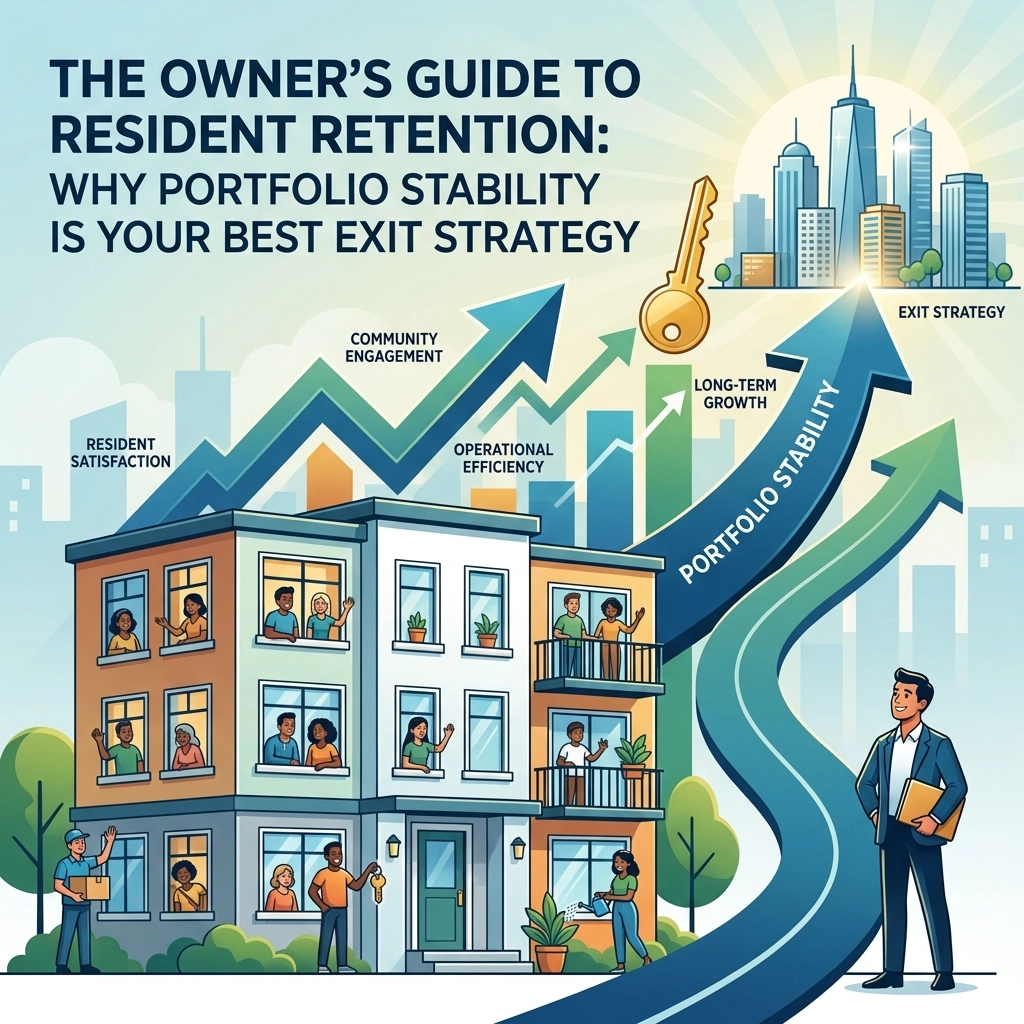
When you start thinking about selling your property management business, your mind likely jumps to your bottom line, your management contracts, and your internal team. These are critical components of a successful exit. However, there is a "silent" value driver that many owners overlook until they are deep in the due diligence process: Resident Retention.
To a buyer, a property management company is only as valuable as the stability of its recurring revenue. If your portfolio is a "revolving door" of residents, a buyer sees risk, high operational costs, and potential churn in the owner-client base.
In this guide, we will explore why portfolio stability, driven by high resident retention, is your most powerful exit strategy and how you can optimize it before you ever list your business for sale.
The Direct Link Between Retention and Your Sale Price
In property management, turnover is the ultimate profit killer. Every time a resident moves out, it triggers a chain of expensive events: marketing, showings, screening, unit turns, and administrative processing. While many firms charge "leasing fees" to owners to offset this, the internal labor cost often eats most of the profit.
From a buyer's perspective, high resident turnover signals a lack of operational maturity. Buyers are looking for predictable income streams. When they evaluate what buyers look for in a property management business, they are looking for "sticky" portfolios where residents stay for years, not months.
A stable resident base leads to:
- Reduced Operational Friction: Your team spends less time on "emergency" leasing and more time on high-value tasks.
- Lower Owner Churn: When residents stay, property owners are happy. Happy owners are much less likely to cancel their management agreements during a transition.
- Higher Multiples: A business that can prove it has a 70%+ renewal rate will almost always command a higher valuation multiple than one struggling at 40%.

Building Trust as a Marketable Asset
Trust is often considered an "intangible" asset, but in the world of business brokerage, it manifests as brand equity. If you are planning your exit strategy, you need to ensure your brand is synonymous with reliability.
Strong resident relationships are built on consistent communication. Residents who feel heard and valued are significantly more likely to renew their leases, even if a small rent increase is on the table.
To improve this before a sale, audit your touchpoints. Are you checking in midway through a lease, or only when it is time to ask for a renewal? A simple automated 6-month "How is your home?" survey can provide the data a buyer needs to see that your residents are satisfied and stable.
Proactive Maintenance: The Key to "De-Risking" Your Portfolio
Poor property upkeep is consistently ranked as the top reason residents leave. From an exit planning perspective, maintenance is about more than just fixing toilets; it is about protecting the asset value for both the owner and the future buyer of your management company.
Proactive maintenance programs reduce the frequency of emergency repairs, which are expensive and frustrate residents. When a buyer looks at your maintenance logs during due diligence, they want to see a history of preventative care.
If your portfolio is plagued by "deferred maintenance," a buyer will see a ticking time bomb. They will assume that as soon as they take over, they will be hit with a wave of move-outs and angry property owners. By cleaning up your maintenance workflows now, you are essentially "pre-inspecting" your business for a future sale.

Creative Lease Renewal Incentives
Many property management owners view lease renewals as a purely administrative task. If you want to maximize your company's value, you need to view renewals as a sales and retention strategy.
Instead of simply sending a notice that rent is increasing, consider pairing that increase with an added-value incentive. Small gestures can have a massive impact on retention rates:
- Property Upgrades: Offer a free professional carpet cleaning or a smart thermostat installation upon renewal.
- Tiered Renewal Options: Give residents the choice between a 12-month and an 18-month lease to lock in long-term stability.
- Early Bird Discounts: Provide a small credit if the renewal is signed 60 days in advance.
These strategies don't just keep residents in place; they create a data set of "Lease Term Remaining" that looks fantastic on a pro-forma for a potential buyer.
Modern Communication: Meeting Residents Where They Are
The property management industry is shifting rapidly. By 2026, the vast majority of your resident base expects digital-first communication. If your office still relies on paper notices and phone tag, you are likely losing residents to more modern competitors.
Buyers are specifically looking for businesses with integrated tech stacks. They want to see that you are using portals for maintenance requests, text messaging for updates, and digital platforms for lease signings.
When you can show a buyer that your resident communication is centralized and automated, you are proving that the business can run without you, the owner, being the bottleneck. This is a critical step in growing your business without becoming the bottleneck.

Evaluating Your Retention Metrics Before You Sell
If you were to list your business today, could you tell a buyer exactly what your average resident tenure is? Could you show them your renewal percentage month-over-month for the last three years?
If the answer is "no," you have some work to do. Before you enter the market, you should perform a "retention audit." This involves:
- Calculating Churn: Determining how many residents you lose annually relative to the size of your portfolio.
- Analyzing Move-Out Reasons: Reviewing move-out surveys to see if there are systemic issues in your management style or property conditions.
- Reviewing Management Agreements: Ensuring your contracts are structured to protect you (and a future buyer) if a resident move-out leads to an owner trying to leave. You can learn more about this in our guide on fixing management agreements before selling.
Why "Waiting Too Long" Can Erode Your Stability
There is a quiet risk in waiting until you are "burnt out" to start focusing on retention. When an owner checks out mentally, the first thing to slip is usually the quality of resident relations and maintenance oversight.
As resident satisfaction drops, turnover increases. As turnover increases, the team becomes overwhelmed. This leads to a downward spiral of property owner dissatisfaction and, eventually, a decrease in the overall value of the business.
We often talk about the quiet risk of waiting too long to plan your exit. If you wait until the business is struggling to maintain its resident base, you will be selling at a discount.

Creating a Community That Buyers Want to Own
Finally, consider the "community" aspect of your portfolio. While this is easier in multi-family settings, it applies to single-family portfolios as well. A management company that fosters a sense of belonging and respect among its residents is a company with a strong culture.
Buyers are not just buying a list of doors; they are buying a culture and a reputation. If your online reviews from residents are positive, it acts as a secondary layer of "due diligence" for a buyer. It proves that the systems you have in place actually work.
Stable residents lead to stable owners. Stable owners lead to a stable management company. And a stable management company is what fetches the highest price in the current market.
Next Steps for Property Management Owners
Resident retention isn't just a management task; it is a financial strategy. If you are starting to see the signs it may be time to sell your property management business, your first priority should be stabilizing your current portfolio.
A business that can prove its residents stay for the long haul is a business that minimizes risk for a buyer. In a market where capital is expensive and buyers are discerning, de-risking your portfolio through retention is the fastest way to increase your exit value.

If you are curious about how your current retention rates and operational structure might impact your company’s valuation, it may be time to speak with a specialist. Understanding how buyers actually value a property management business is the first step in ensuring you don't leave money on the table when you finally decide to walk away.
Whether you are ready to sell today or are looking to exit in the next three to five years, focusing on the resident experience will pay dividends when the clock finally decides it's time for your next chapter. For more insights on preparing your business for a smooth transition, visit our full blog library.